Holding Steady
The Strategy Shift
Somewhere in the middle of this week something became clear.
The original plan was to gradually build toward Sooke Hills 50k on May 30th — adding volume carefully, watching the baseline, hoping the heels held together. The problem with that plan is that it assumes the baseline stays at 3/10 as load increases. That’s not guaranteed, and it’s a pattern I know well. I’m good at pushing through pain when I ramp up load. Too good, probably. That trait has kept me in races and training blocks where I should have backed off, and it’s part of why I’ve been managing this problem for 8 years rather than resolving it.
So the plan changed. I’m skipping Sooke Hills. Instead of increasing load and hoping pain stays at 3/10, I’m holding load steady and waiting for pain to drop to 2/10. Then I build from a stronger foundation.
It’s the inverse of how I usually train — patience as the variable instead of fitness. Harder than it sounds.
The exception is adventures. If something like a big mountain day with Riki comes up, that’s going. Structured training load stays conservative.
Week 3: Day by Day
Monday — Island Endurance Morning stiffness 3/10. First time since switching to zero drop that I ran at something close to normal effort. The session was a threshold workout with Island Endurance — 3.91 miles, 479ft of gain, 8:41/mi average. Pain stayed at 3/10.
The more interesting thing was the feeling. At times I noticed myself overstriding — defaulting to old mechanics under pressure. At normal effort in zero drop the neuromuscular patterns haven’t fully reprogrammed yet. The pace wants to come from a longer stride rather than from better mechanics.
Tuesday 60 min easy spin bike. Also moved 90 minutes worth of dirt into garden beds — a reminder that non-running load counts toward total achilles stress.
Wednesday Another 60 min easy spin bike. Recovery holding well.
Thursday — Mt. Doug/PKOLS 5.25 miles, 77 minutes, 1,247ft of gain. Pain 3/10. Left peroneal tendon attachment site was noticeable — a recurring issue that comes and goes, not new. On the runnable sections I felt slow, having to consciously shift gears to pick up pace. Form focus does that — when you’re thinking about mechanics you’re not running on autopilot, and autopilot is faster in the short term.
Friday — Track 200s 8x200m at Oak Bay with 200m walk/jog recovery. Morning stiffness 3.5/10. Pain during 3-4/10. The session got faster as it went — first fast lap at 6:09/mi pace, last at 5:13/mi. The last two or three reps felt genuinely springy, like the foot was responding elastically rather than each step being an effort. That’s the zero drop mechanics starting to work the way they should.
Left soleus and peroneal were calling for attention again. Worth monitoring.
Also used the Ochy app to analyze my running mechanics during the warmup. Key findings: cadence at 182 spm which is excellent, ground contact time good at 0.19 seconds, front knee angle at ideal position. The areas to work on — moderate overstride, not sufficiently forward leaning, arms swinging too far back. These are all connected. The arm swing is the priority fix because correcting it cascades into the lean and the foot strike naturally. High cadence doesn’t automatically fix overstride — you can take 182 steps per minute and still land each foot ahead of your center of mass. That’s exactly what’s happening.
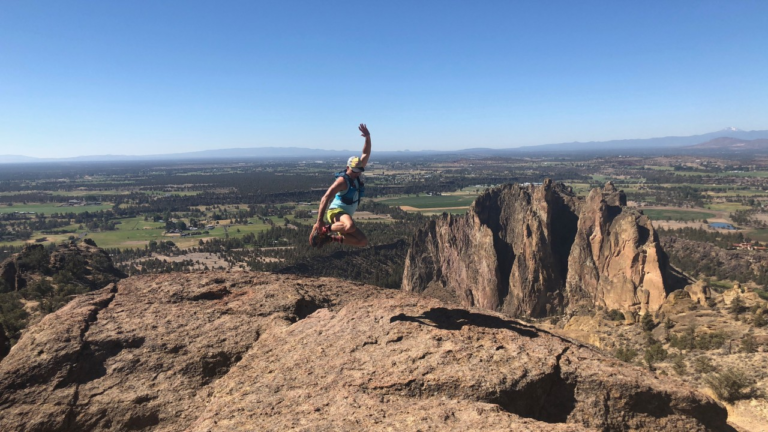
Saturday — Mount Arrowsmith/Mt. Cokely with Riki This was not a structured training run. This was the exception to the holding steady plan — a big mountain day that was too good to pass up.
12.15 miles, 6 hours 17 minutes, 4,298ft of gain in Mount Arrowsmith Regional Park. Pain started at 3/10, built to 4/10 through the middle section, hit 5/10 in the last 90 minutes, then dropped back to 3/10 near the top. Ran in Lone Peaks rather than Escalantes — the more rigid heel counter was noticeable and likely contributed to the pain in the middle section. The Haglund’s doesn’t respond well to firm heel counters under sustained load and fatigue.
The drop back to 3/10 near the summit is interesting — probably a combination of slowing down, more hiking, and the terrain changing how the heel loaded.
This was exactly the kind of hike/run effort needed for Fatdog adaptation. Lots of hiking, big vert, long duration, done with Riki. More of this.
Sunday 50 min easy bike, 10 miles. Feeling better through the day.
What the Week Showed
The most significant session was the Island Endurance workout on Monday — first time running at real effort in zero drop. 3/10 pain at threshold pace is a meaningful data point.
The track session confirmed something useful: high cadence doesn’t fix overstride automatically. The Ochy analysis made the mechanical picture clear — cadence is already where it needs to be, the work now is forward lean and arm swing. Those corrections will bring foot strike back under the hips naturally.
The springy feeling on the last few 200s is the adaptation showing up in real time. The foot is starting to respond elastically rather than just absorbing load passively. That’s what zero drop training is supposed to build.
The mountain day was the biggest effort of the experiment by a significant margin. The response has been encouraging — 4/10 the morning after, settling to 3/10 through the day. Two weeks ago a 60 minute hill run left me at 5/10 for two days. The recovery response is improving.
The New Benchmark
The goal for the next 3-4 weeks is simple: hold training steady at current volume and wait for morning stiffness to drop from 3/10 to 2/10 consistently. If the baseline improves at the same load, that’s evidence the tissue is actually remodeling — not just tolerating. Then volume gets added from a stronger foundation.
No Sooke Hills. Knee Knacker on July 11th is the next target. Fatdog 100k on August 9th still a question mark. The true success would be rebuilding my heals…not finishing another 100k.
Morning stiffness and pain: 1-10 scale. Running in Altra Escalante (zero drop) unless noted. Lone Peaks noted where used.