‘Catch you on the flip side’
I have a thought I keep coming back to — that I can’t actually be recovering this much just from switching to zero drop shoes and focusing on my form. It seems like too simple an explanation for the change. So, dear reader, if you’re doubting it, I get it. I’ve been doubting it the whole way through. But I’ve been keeping this daily log, and it’s true.
I think I’m coming out the other side of the “regress” part…”into just progress”
Seven weeks into the running-specific phase of this rehab, and I’m basically back to where I was before I switched to zero drop. In a lot of ways I’m ahead of that now. I’m definitely ahead of where I was last summer, when I couldn’t walk around a campsite without my heels hurting and I barely ran the whole trip.
The last piece I’m chasing is being able to put together a full, normal structured training week — two intensity days, a medium long run, and a long run. I got close two weeks ago – I might hit it this week. That’s the marker I’m watching for now. Not a race, not a pace — just the ability to train the way I used to without my heels governing everything.
Mt. Cokely
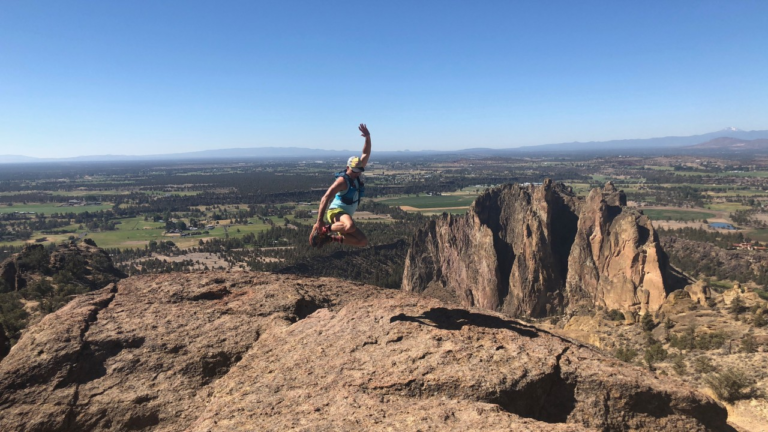
On Satruday I ran up Mt. Cokely – via the CPR trail. It’s up near Port Alberni on Vancouver Island, about two and a half hours’ drive from Victoria, and it’s one of the better big mountain trail runs within range of the city. An out and back, nearly 4 hours, 4,852ft of climbing, in my Escalantes — a run I’d normally do in Hoka Speed Goats.
For anyone in Victoria training for a mountain ultra — Knee Knacker, Fatdog, or anything with serious vert — Mt. Cokely is a useful day out. The sustained climbing, the technical sections, and the runnable descent make it a real test of trail fitness and mechanics, and it’s close enough to do as a day trip from town.
It was beyond where my recovery is right now, but not by much. My legs were fried by the top. There was still snow up high, which slowed the final pitch both directions. Coming back down when it got runnable I was surprised how good I felt. But the last hour my muscles were cooked, my mechanics fell apart, I was catching my feet, and I had one small fall. By the end it felt like the old days…my heels freaking hurt!
But it wasn’t an entire run of heel pain like it would have been before. It was maybe the last 45 to 60 minutes. The big toe engagement and the better mechanics bought me three good hours before the heels really started talking. That’s new.
And the recovery was the real headline. Saturday evening it hurt to walk, but I wasn’t shuffling — and usually I’d be shuffling. By Sunday I was walking normally with minor pain, and I mowed the lawn in regular shoes and went for a short run with my 7 year old. By Monday I was at 0/10 with just a bit of quad soreness. Two days after the biggest effort of the entire rehab.
That kind of recovery is something I haven’t experienced in years.
What I’m Learning
A few things are becoming clear.
The pain isn’t gone, but its character has changed. It’s less the sharp insertional stuff and more general muscular fatigue — soleus, calves, even the small muscles in my feet getting sore. (With the occasional heel flare up.)
I’ve also figured out that the big toe and the windlass mechanism are a real lever. When I consciously engage my big toe, the sharp peroneal pinch I’d get on hard or downhill running just disappears. It takes mental effort right now, but it works. As my foot muscles strengthen, I expect that to become automatic.
Which brings me back to the doubt I started with. When I met with Dr. Ray McClanahan last August, he told me he’d never had anyone really commit to healing their feet through footwear and toe spacers — Correct Toes — who didn’t basically fully recover. I didn’t believe him at the time. But I’m starting to.
The Week Ahead
The plan is a full structured week at about 70-80% of normal volume and intensity — an Island Endurance workout, a 75 minute trail run, some faster work on Friday, an easy run, and a 90 minute long run on Sunday.
If it goes well, I’ll try it at full the following week. That’s the last box to tick on the way out of “regress” and fully into “progress.” And if I’m feeling good this week, I might just let it rip and give it a go now.
Morning stiffness and pain: 1-10 scale. Running in Altra Escalante (zero drop) unless noted. I’m using Claude as a daily training and rehab log — tracking morning stiffness, pain levels, sessions, and patterns in real time. These blog posts are written with Claude’s help, pulling from that ongoing log each week.