“If you want to destroy my sweater, pull this thread as I walk away, as I walk away”
There’s a version of this blog where I tell you week nine went great. That’s not this post.
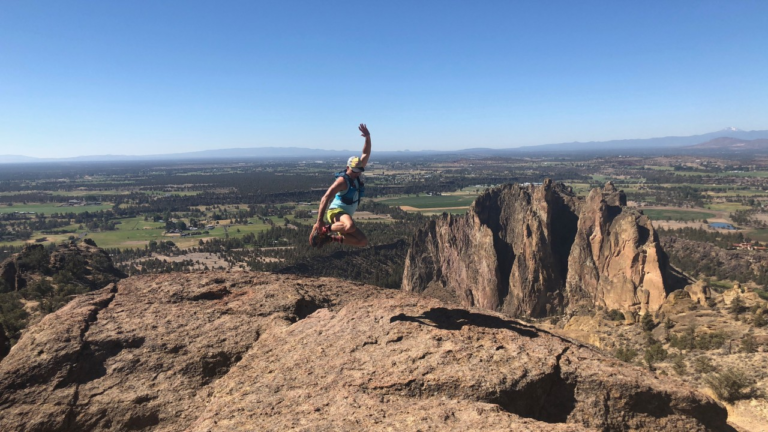
Something I’ve been sitting with lately is the idea of root causes. Not symptoms, not the thing that hurts right now, but the underlying reasons things keep breaking down. That line of thinking started with my heels. Eight months ago I began addressing the Achilles and Haglund’s situation in a real way — transitioning to zero-drop footwear, working with Dr. Ray McClanahan’s guidance, rebuilding from the ground up. And I made genuine progress. I can walk in Birkenstocks and barefoot without pain. I did the Mount Cokely out-and-back in zero-drop shoes. I had that stretch of running in Oregon that reminded me why I do this. Real progress on a problem I’d been ignoring for years.
But then I pulled on another thread.
I’ve had headaches since I was a kid. Migraines. They’ve been part of my life for so long I stopped questioning them. What I didn’t fully reckon with until recently is that the medication I’ve been taking to manage them — Aleve, chronically, for a long time — had itself become part of the problem. Medication overuse headache. The thing you take to treat the pain becomes a root cause of the pain. I’m now in week two of withdrawing from it, using rimegepant only as needed, and it’s stirring things up. My heels are more reactive. My headaches are louder. That’s expected — it’s what happens when you stop overusing pain medication — but it doesn’t make it easier to sit with.
And then there’s the third thread, which connects everything. I’ve been reading Marius Bakken’s book on the Norwegian training method, and his framework is built on one central idea: the muscular system — not the cardiovascular system — is the real limiter. Chronic excessive tension, inadequate recovery, training too hard too often. The book feels like it is written directly at me. I do one good week of training, and by the end of the second week I’ve blown it. My capacity is low. My body has been telling me for a long time that it needs more recovery than I’ve been giving it, and because I haven’t been listening, it’s becoming less and less tolerant of anything.
So here’s where I’m at. I have three things in confluence: years of accumulated overtraining and chronic muscle tension, a medication overuse headache cycle I’m now withdrawing from, and an Achilles situation that’s improved but is still sensitive. All three are connected. All three involve the same underlying pattern — not giving my body what it actually needs, and overriding the signals when it tells me so.
To the regulars at Island Endurance who’ve been showing up on Tuesday evenings — if you’ve been paying any attention to how I’ve been running over the last couple of years, what I’m describing here has probably been more obvious to you than it was to me. The dropped races, the stretches where I don’t train with the group, the weeks where I show up limping. The pattern has been there. I just kept finding reasons to push through rather than asking why it kept happening. That’s what I’m finally trying to answer.
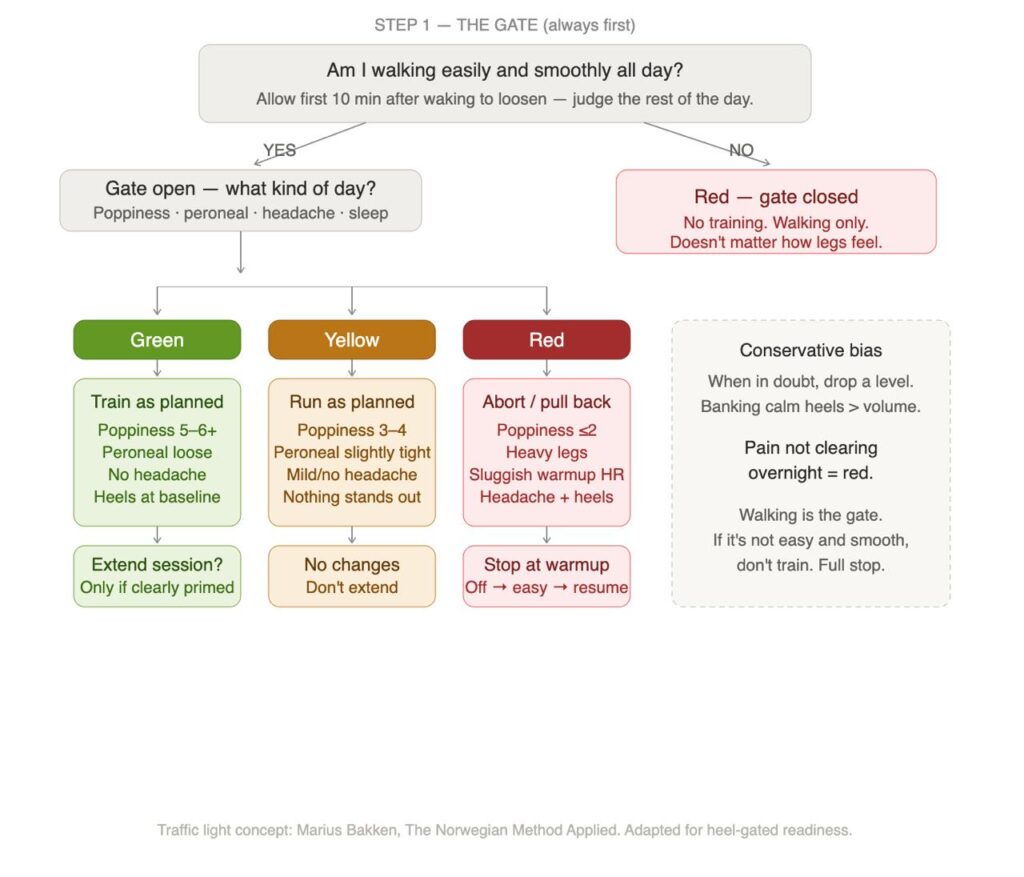
For training, I’m following a modified version of Bakken’s traffic light system. Green, yellow, red — assessing before every quality session based on how the body feels. But I’ve added my own gate at the front: if I wake up and after a few minutes of moving around I’m not walking easily and smoothly, I don’t train. Full stop. No convincing myself otherwise. If it takes three or four days before I pass that gate, then that’s how long it takes. The schedule bends to the body, not the other way around. So for now, I’m doing about 1hr of walking per day, waiting for the gate to open up.

Acutely, the MOH withdrawal takes four to six weeks. The deeper recalibration — cooling down a nervous system that’s been wound up for years through chronic overtraining, chronic headaches, and chronic pain — probably takes a year or more.
On one hand, I feel encouraged. I’m finally listening. On the other, it’s hard. I just want to train and run. Sitting with a closed gate on a Tuesday morning, watching everyone else head out, is its own kind of discipline — maybe the harder kind.
There’s a word I keep coming back to right now: confluence. All these different things — the heels, the headaches, the overtraining, the medication — pointing toward one thing. In Buddhism there’s a concept called satori, a moment of sudden clarity, of seeing things as they actually are. I don’t want to oversell what this is, but it feels something like that. A momentary openness to the truth of the situation rather than the version I’d been hoping for. I thought the answer was zero-drop shoes and getting back to training. That’s not the whole answer. The reality is bigger and slower and less convenient than I wanted. But I’d rather face that than keep manipulating myself into thinking I’m one good training block away from being fine. Something’s been missing for a long time, and I’ve felt it without being able to name it. What’s different now isn’t that things are better — they’re not, not yet. It’s that I feel something true behind them. That’s worth something.
I’m using Claude as a daily training and rehab log — tracking morning stiffness, pain levels, sessions, and patterns in real time.